Rewards App
Shaping a rewards ecosystem across discovery, wallet, referrals, gamification and engagement.
At a glance
Supported by one product foundation
Mobile and responsive web, one architecture
From pre-sales prototype to production
The problem
The brief looked like a redesign, but it was really a scalability problem. Members think in brands, not reward categories. Each brand needed to feel distinct, and launching a new brand should not mean a new design and engineering build.
What I changed
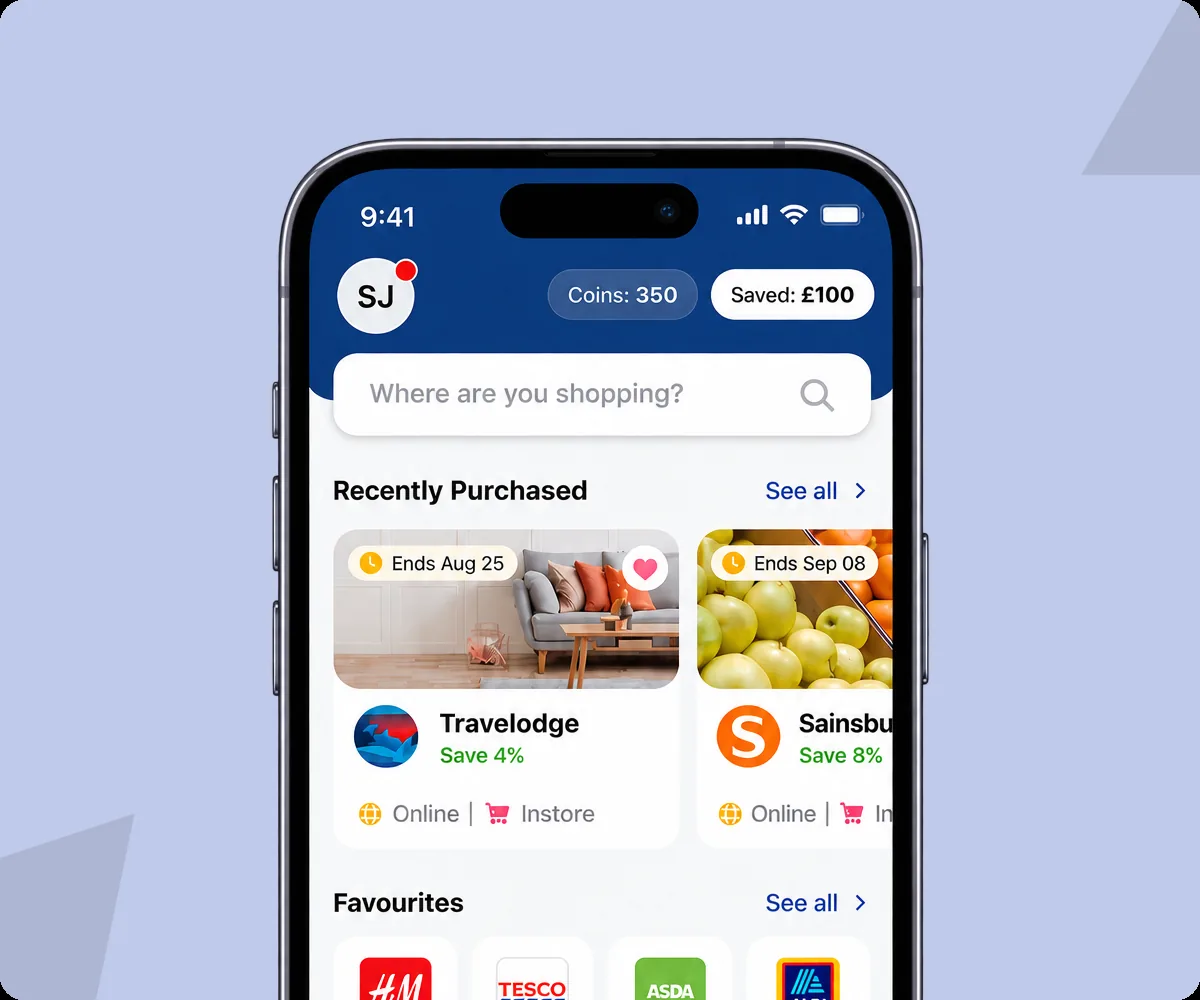
I turned the requirements into a clickable pre-sales concept that helped win the engagement. Discovery shifted from Platform → Category → Reward to Brand → Reward → Action, starting with "Where are you shopping?". One shared architecture carries the IA, journeys and components, with a brand layer for logo, colour, type and imagery.
The detail
A token pipeline (Tokens → Components → Patterns → Journeys → Brand themes) makes each brand a configuration, not a rebuild. Coins and Saved £ stay visible in the mobile header to encourage repeat engagement, and CMS workflows let the team update rewards and promotions without a designer.
What I learned. The hardest part was deciding what stays constant and what can vary. Separating product experience from brand expression turned the design system into a tool for scaling the business.
What happened
Brand search, rewards, wallet, gift cards with Buy & Win, referrals and account management. Mobile is in production and web is progressing toward launch. Success will be tracked through monthly redeeming members, reward-to-redemption rate and time to launch a new brand.
Full case study
The complete story
Overview
One product foundation. Ten distinct brands.
A multi-brand membership rewards platform for the UK, combining discounts, gift cards, referrals, prize draws and member benefits. The goal wasn't just to redesign an app, but to build one foundation flexible enough for 10 brands while staying coherent and efficient to run. I led product design from pre-sales and strategy through mobile, responsive web, the design system and CMS thinking.
Challenge
A scalability problem in three dimensions
- Member discovery: members arrive knowing the brand they want, not the platform's categories.
- Brand identity: each brand had to feel native, not the same app with a new logo.
- Product scalability: launching or changing a brand shouldn't mean building another product.
Guiding question: how might we make rewards easier to discover while building a foundation that scales across brands?
Pre-sales
From requirements to product direction
I turned the requirements document into a product proposition and a clickable concept, so stakeholders could judge structure, core journeys and scalability, not just visuals. It helped win the engagement, which later expanded from mobile into responsive web.
Discovery
Designing around the member's mental model
I built on the client's existing research, adding stakeholder conversations, competitor and analytics review, and mental-model exploration.
| Order | |
|---|---|
| Existing structure | Platform → Category → Reward → Action |
| Member mental model | Brand → Reward → Action |
So the experience now starts with what members already know. Brand search, recent brands and favourites come first, and categories become an exploration layer, led by one question: “Where are you shopping?”
System
One product, 10 brands
- Shared foundation: information architecture, navigation, core journeys, interaction patterns, components, states and business rules.
- Brand layer: logo, colour, typography, imagery, content, promotional emphasis and selected feature variations.
The design system became part of the product strategy, not just a UI library.
Member behaviours
Six things members come to do
| Behaviour | Experience | Role in the journey |
|---|---|---|
| Discover | Home / Shop | Find brands and rewards, with recent and favourite brands early |
| Save | Rewards | Show value and redemption context before action |
| Manage | Wallet | Coins, savings and benefits in one place |
| Buy | Gift cards | Browse → choose → confirm → purchase, with Buy & Win |
| Share | Referrals | Invite → share → track |
| Control | Account | Manage the member relationship |
Retention
Designing for repeat value
Coins and Saved £ stay visible in the mobile header, so members always see the value they're building. It also created a testable hypothesis about returning-member behaviour.
Web & CMS
One product across two surfaces, run by the team
Mobile came first. Once the core experience and system were set, the work expanded to responsive web: not a desktop copy of the app, but the same IA, journeys, components and tokens adapted for denser layouts and desktop interaction.
I also shaped CMS and content workflows so teams can update rewards, brand content, promotions and assets without needing a designer for every change.
Decisions
Optimising for scale, speed and maintainability
| Area | Chose | Over |
|---|---|---|
| Brand flexibility | Token-based theming and configuration | Custom interfaces per brand |
| Discovery | Brand-led discovery | Category-first navigation |
| Delivery | Core mobile journeys first | Waiting for full cross-platform parity |
| Content | CMS-driven updates | Designer dependency for operational changes |
Impact
Structural and product-facing outcomes
- 10 brands on one shared product foundation
- 2 platforms from one experience architecture
- ~4 months of product design
- Mobile is in production; web is progressing toward launch
| Measure | Signal |
|---|---|
| North Star | Monthly members who redeem at least one reward |
| Activation | Time from app open to first reward viewed |
| Engagement | Reward discovery to redemption rate |
| Commercial | Gift-card purchase conversion |
| Retention | 30-day active members and repeat redeemers |
| Growth | Referral invites to successful referrals |
Learning
What should never change, and what can vary
The hardest part wasn't designing 10 branded experiences. It was deciding what stays constant and what's allowed to vary. Separating product experience from brand expression turned the design system into a way to scale the business.
Have a problem like this?
Tell me what is slowing your team down and I will reply within a day.
Next case study
Edu Fintech
Designing a role-based education-financing platform for parents, schools, investors and operations.